

On-Prem AI Agents for Competitive Intelligence
In the current global economic landscape, information asymmetry is the only remaining sustainable competitive advantage. For the modern enterprise, the ability to synthesize vast quantities of external data – market signals, regulatory shifts, and competitor movements—into actionable strategy is no longer a back-office research function. It is a core pillar of fiduciary responsibility and corporate resilience.
However, a critical paradox has emerged. While generative AI offers unprecedented analytical power, the standard delivery model—public cloud-based SaaS—creates unacceptable strategic risks. Every query, every uploaded document, and every strategic hypothesis fed into a third-party AI model risks leaking a firm’s “mental model” to the broader market.
To bridge this gap, forward-leaning organizations are adopting Zero-Trust Competitive Intelligence (CI). By deploying autonomous AI agents within an on-premises, Zero-Trust architecture, enterprises can harness the full power of global data without ever compromising the privacy of their strategic intent.
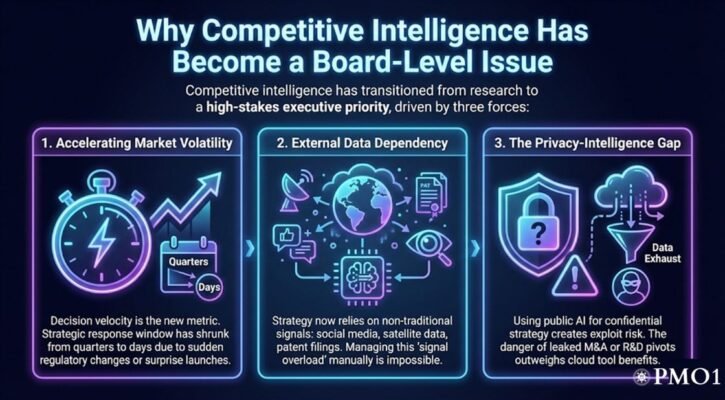
Why Competitive Intelligence Has Become a Board-Level Issue
Competitive intelligence has transitioned from a specialized research task to a high-stakes executive priority. This shift is driven by three primary forces:
-
Accelerating Market Volatility: The window for strategic response has shrunk from quarters to days. Whether it is a sudden regulatory change in a key market or a competitor’s surprise product launch, “decision velocity” is now the primary metric of successful leadership.
-
External Data Dependency: Modern strategy, particularly in M&A and global expansion, relies heavily on non-traditional signals—social media sentiment, satellite data, patent filings, and obscure regulatory disclosures. Managing this “signal overload” manually is impossible.
-
The Privacy-Intelligence Gap: Using public AI tools to analyze confidential market hypotheses creates a “data exhaust” that competitors or third-party providers can potentially exploit. For a CEO, the risk of a leaked M&A interest or a pivot in R&D strategy outweighs the benefits of a standard cloud-based analytical tool.
Strategic CI is no longer about finding information; it is about protecting the intent behind the search.
What “Zero-Trust Competitive Intelligence” Really Means
Zero-Trust is often discussed in the context of identity management or network security. In the context of competitive intelligence, Zero-Trust CI refers to an architecture where no entity—internal or external—is inherently trusted with the enterprise’s strategic queries or sensitive data insights.
Defining the Difference
-
Traditional Market Research: Relies on human analysts and static reports. It is slow and lacks the scale to process real-time global signals.
-
SaaS CI Platforms: Offer speed but require data to reside on third-party servers. This creates a “black box” regarding how your data is used to train future models or who has access to your search history.
-
Zero-Trust CI: Utilizes on-prem AI agents that operate behind the corporate firewall. These agents pull external data in, but never push strategic queries out.
This approach ensures trust-by-design. The enterprise maintains absolute sovereignty over its analytical processes, ensuring that the “why” behind an inquiry remains as private as the “what.”
How On-Prem AI Agents Ingest and Analyze External Data
On-premises AI agents function as a secure “digital twin” of a strategy department. They are designed to operate at the edge of the corporate network, serving as a one-way valve for information.
The Ingestion and Analysis Workflow
-
Secure Ingestion: AI agents are programmed to crawl and ingest diverse external sources—news feeds, analyst coverage, social signals, and public market filings—directly into a secured, on-prem environment.
-
Normalization and Enrichment: Once the data is inside the perimeter, the agents clean and categorize it. They apply natural language processing (NLP) to identify hidden links between seemingly disparate events, such as a localized regulatory change in Southeast Asia and its impact on a global supply chain.
-
Pattern Detection and Reasoning: Unlike basic search tools, AI agents apply “reasoning layers” to identify non-obvious patterns. They can simulate “what-if” scenarios based on competitor data without the scenario parameters ever leaving the local server.
-
Insight Surfacing: The output is a high-level executive briefing that highlights risks and opportunities. Crucially, the raw data and the logic used to reach the conclusion stay within the enterprise control plane.
Zero-Trust Architecture: Why It Matters Now
From a CIO or CTO perspective, the architecture is the most critical component of this strategy. A Zero-Trust posture ensures that even if one part of the system is compromised, the integrity of the strategic intelligence remains intact.
Core Security Principles for CI
-
No Implicit Trust: Every request for information, whether from an executive or an automated script, must be verified and authenticated.
-
Least-Privilege Access: AI agents are granted access only to the specific data sets required for their current task. This prevents “lateral movement” of data if a specific ingestion channel is compromised.
-
Full Auditability: Every action taken by an AI agent—every source visited and every report generated—is logged. This provides a clear trail for compliance and risk governance, which is vital in highly regulated industries like Finance or Healthcare.
By positioning Zero-Trust as a foundation, security becomes an enabler of innovation rather than a bottleneck. It allows the Strategy team to experiment with aggressive market hypotheses in a completely safe sandbox.
Strategic Value for CXOs
The move to on-prem, Zero-Trust CI delivers outcomes that directly impact the bottom line and the firm’s long-term valuation:
-
Information Asymmetry: By analyzing data more deeply and privately than competitors using public tools, leadership gains a “clearer view” of the market landscape.
-
Reduced M&A Risk: Perform deep-dive diligence on targets by analyzing every public filing and social signal globally, without signaling your interest to the market or the target company.
-
Protection of Proprietary Strategy: In highly competitive sectors (e.g., Pharmaceuticals or Aerospace), the mere knowledge of what a company is researching is a valuable trade secret. Zero-Trust CI keeps those research vectors invisible.
-
Increased Decision Velocity: Reduce the time from “signal detection” to “strategic move” from weeks to minutes, allowing the firm to capture fleeting market opportunities.
Operating Model Implications
Implementing Zero-Trust CI is not a simple software installation; it requires a shift in the corporate operating model.
Structural Requirements
-
The Strategy-IT-Security Triad: The Chief Strategy Officer, CIO, and CISO must operate in lockstep. Strategy defines the “intelligence requirements,” IT provides the “on-prem compute,” and Security ensures the “Zero-Trust perimeter.”
-
Data Sovereignty Governance: Clear policies must be established regarding what data can be ingested and how the resulting insights are distributed across the executive leadership team.
-
Talent Evolution: Strategy teams will need “AI Orchestrators” – professionals who understand both market dynamics and how to prompt and manage on-prem AI agents effectively.
What CXOs Should Do Now: A Decisive Roadmap
To transition to a Zero-Trust CI model, the Board and the C-Suite should follow a structured three-phase approach:
1. Identify High-Stakes Use Cases
Focus on areas where information leakage would be catastrophic. This typically includes M&A diligence, entry into new geographic markets, or monitoring of disruptive technological threats.
2. Pilot On-Prem AI Agents
Deploy a “contained” instance of an AI agent within a secure data center. Use it to analyze a specific, non-critical market segment to validate the speed and quality of insights before scaling to the entire enterprise.
3. Measure Success Beyond ROI
Evaluate the system based on:
-
Lead Time: How much faster was the insight generated compared to traditional methods?
-
Signal Quality: Did the AI identify a risk or opportunity that human analysts missed?
-
Security Integrity: Were there any data egress attempts or unauthorized access requests?
The Bottom Line: In an era where AI is becoming a commodity, the privacy and security of your intelligence is your only true differentiator. On-prem AI agents, governed by Zero-Trust principles, ensure that your strategy remains your own – private, powerful, and unassailable.
—————————
PMO1 is the Local AI Agent Suite built for the sovereign enterprise. By deploying powerful AI agents directly onto your private infrastructure, PMO1 enables organizations to achieve breakthrough productivity and efficiency with zero data egress. We help forward-thinking firms lower operational costs and secure their future with an on-premise solution that guarantees absolute control, compliance, and independence. With PMO1, your data stays yours, ensuring your firm is compliant, efficient, and ready for the future of AI.