

From Chatbots to Autonomous Strategy Agents: Turn Data Into Competitive Edge
The initial wave of Generative AI was defined by novelty and experimentation. Organizations rushed to deploy chatbots and conversational interfaces, seeking efficiency gains in customer service and coding assistance. While valuable, these implementations represent only the surface of AI’s potential. We are now witnessing a fundamental structural shift: the transition from passive, text-based chatbots to Autonomous Strategy Agents.
For the C-suite, this is not merely a technical upgrade; it is a shift in the mechanism of enterprise value creation. While chatbots retrieve information, agents perform work. While copilots assist, agents reason.
Leading organizations are moving beyond “chatting with data” to building systems that can autonomously analyze complex scenarios, plan multi-step workflows, and execute strategic decisions within safe, governed parameters. This article outlines the roadmap for turning this technological capability into a sustainable competitive edge.
The Evolution of Enterprise AI: From Retrieval to Reasoning
To understand the strategic imperative, one must recognize the trajectory of AI maturity. We observe three distinct phases in the enterprise adoption cycle.
Phase 1: Rule-Based Automation & Chatbots
This phase focuses on efficiency. Systems follow rigid “if-then” logic (RPA) or use basic Natural Language Processing (NLP) to retrieve static answers from documentation. These tools reduce manual toil but lack context and adaptability.
Phase 2: Context-Aware Copilots
Current state for many enterprises. Large Language Models (LLMs) assist humans by summarizing meetings, drafting code, or synthesizing reports. The human remains the driver; the AI is a sophisticated navigational aid.
Phase 3: Autonomous Strategy Agents
The emerging frontier. These agents possess agentic reasoning. They do not just predict the next word; they predict the next necessary action to achieve a goal. They can:
-
Decompose complex strategic problems into sub-tasks.
-
Access and orchestrate external tools (ERPs, APIs, databases).
-
Critique their own outputs and iterate to improve accuracy.
-
Execute decisions across cross-functional domains.
Defining the Autonomous Strategy Agent
It is critical to strip away the hype. An Autonomous Strategy Agent is not simply a more powerful chatbot. It is a software system capable of perceiving its environment, reasoning about how to achieve a specific objective, and acting upon that reasoning to change the state of the enterprise.
The core differentiator is Decision Intelligence.
Unlike Generative AI interfaces which rely on probabilistic text generation, Strategy Agents utilize reasoning loops (such as ReAct or Chain-of-Thought frameworks) to validate logic before execution. They differ from Traditional Analytics and RPA in fundamental ways:
-
vs. Traditional Analytics: Analytics provide the dashboard; agents read the dashboard and recommend—or execute—the adjustment.
-
vs. RPA: RPA mimics keystrokes for repetitive tasks; agents mimic cognitive processes for variable tasks.
For a Chief Strategy Officer, this means deploying digital workers capable of continuous market scanning and scenario planning, operating 24/7 with zero fatigue.
Turning Data Into Competitive Advantage
Data is only a competitive advantage if it translates into faster, higher-quality decisions. Autonomous agents bridge the gap between raw data and strategic action by integrating structured (SQL databases, Excel) and unstructured (PDFs, emails, market news) data into a unified reasoning layer.
Anticipating Market Shifts
Advanced agents can monitor thousands of data points—competitor pricing, geopolitical news, supply chain disruptions—in real-time. By connecting these disparate signals, they perform predictive reasoning.
-
Example: An agent detects a raw material shortage in Southeast Asia, correlates it with current inventory levels in the ERP, and automatically drafts three mitigation strategies for the COO to review.
Optimizing Capital Allocation
Agents can simulate thousands of capital allocation scenarios, weighing risk-adjusted returns against corporate strategy constraints. This moves planning from a quarterly static exercise to a continuous dynamic process.
Real-Time Execution
In high-velocity environments like algorithmic trading or dynamic pricing, human latency is a liability. Agents can autonomously adjust pricing strategies within pre-approved guardrails to maximize margin, reacting to demand spikes instantly.
The Governance Imperative: Security-First AI
As power increases, so does risk. The transition to autonomy requires a “Security-First” executive stance. The primary risks are no longer just data leakage, but unauthorized action and flawed reasoning (hallucination).
The Control Tower Concept
Enterprises must establish an AI Control Tower—a centralized governance framework that monitors agent behavior. This includes:
-
Deterministic Guardrails: Hard-coded rules that agents cannot override (e.g., “Never approve a transaction over $50k without human biometrics”).
-
Human-in-the-Loop (HITL): Strategic agents should operate with varying levels of autonomy based on risk. High-stakes decisions must require human ratification.
-
Auditability: Every step of the agent’s “thought process” must be logged. We must be able to trace why an agent recommended a specific strategy.
Data Privacy and Model Drift
Deploying agents requires rigorous adherence to GDPR, CCPA, and internal compliance standards. Furthermore, CIOs must monitor for model drift—where an agent’s performance degrades as market data shifts away from its training distribution.
The Operating Model Shift
Technology implementation is the easy part; organizational transformation is the bottleneck. To support autonomous strategy, the enterprise operating model must evolve.
Architecture: The Composable Enterprise
Legacy monolithic systems stifle agents. CIOs must prioritize a composable architecture where data and functions are exposed via APIs. Agents require a “nervous system” of connectivity to ERPs, CRMs, and Supply Chain Management (SCM) systems to function effectively.
Talent: The Rise of the AI Architect
The demand for “prompt engineers” is fleeting. The enduring need is for AI Architects and Agent Orchestrators—senior technical talent who understand how to design multi-agent systems and integrate them into enterprise workflows.
Decision Rights
Leadership must explicitly define decision rights. Which decisions are delegated to the machine? Which remain with the human? This requires a clear taxonomy of decisions based on risk and reversibility.
What Leaders Must Do Now: An Executive Roadmap
Waiting for the technology to “stabilize” is a losing strategy. The following roadmap outlines immediate steps for C-suite leaders to capture the agentic advantage responsibly.
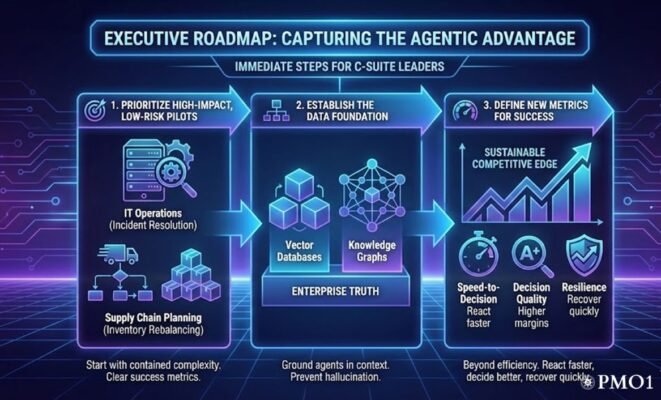
1. Prioritize High-Impact, Low-Risk Pilots
Do not start with the corporate strategy. Start with contained complexity.
-
Recommendation: Pilot autonomous agents in IT Operations (incident resolution) or Supply Chain Planning (inventory rebalancing). These areas offer structured data and clear success metrics.
2. Establish the Data Foundation
Agents cannot reason without context. Invest in Vector Databases and Knowledge Graphs to ground your agents in enterprise truth. Without this, agents are merely hallucinating statisticians.
3. Define New Metrics for Success
Move beyond “efficiency” and “FTE reduction.” The metrics that matter for autonomous strategy are:
-
Speed-to-Decision: How much faster can we react to a market change?
-
Decision Quality: Do agent-assisted decisions yield higher margins?
-
Resilience: How quickly does the system recover from supply shocks?
The shift to Autonomous Strategy Agents represents the next great divide in enterprise capability. Those who view AI as merely a productivity tool for drafting emails will see incremental gains. Those who view it as a reasoning engine for strategic execution will define the market. The technology is ready; the question is whether your organization possesses the discipline to govern it and the vision to deploy it.
—————————
PMO1 is the Local AI Agent Suite built for the sovereign enterprise. By deploying powerful AI agents directly onto your private infrastructure, PMO1 enables organizations to achieve breakthrough productivity and efficiency with zero data egress. We help forward-thinking firms lower operational costs and secure their future with an on-premise solution that guarantees absolute control, compliance, and independence. With PMO1, your data stays yours, ensuring your firm is compliant, efficient, and ready for the future of AI.