

Category Management AI Agents that Cluster Spend, Suggest Savings, and Track KPIs
The traditional category management lifecycle—a cycle of annual strategy refreshes, manual data normalization, and retrospective reporting—is no longer fit for purpose in a volatile global economy. For the Chief Procurement Officer (CPO), the gap between “spend identified” and “value captured” is often widened by data latency, fragmented ERP systems, and an over-reliance on manual analyst intervention.
To move beyond incremental improvements, the enterprise must transition to Category Management Ai Agents. This is not a mere upgrade to existing spend analytics; it is a fundamental shift toward continuous intelligence. By deploying AI agents that utilize local, unsupervised clustering algorithms, procurement organizations can achieve a self-maintaining taxonomy, real-time savings identification, and board-ready KPI visibility with unprecedented speed and security.
The Strategic Bottleneck: Why Manual Category Management is Slow
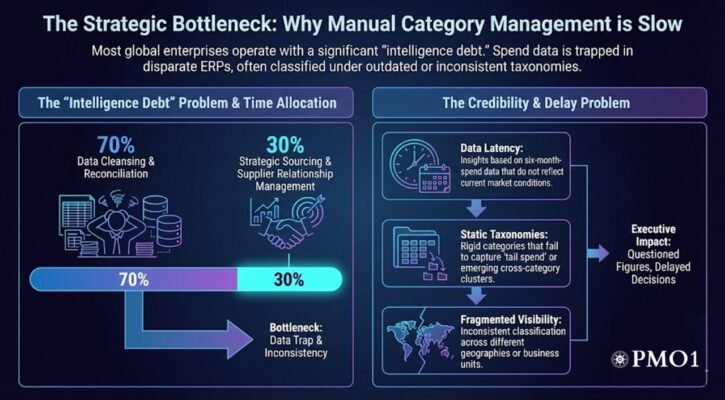
Most global enterprises operate with a significant “intelligence debt.” Spend data is trapped in disparate ERPs, often classified under outdated or inconsistent taxonomies. Category managers spend 70% of their time on data cleansing and reconciliation, leaving only 30% for strategic sourcing and supplier relationship management.
This creates a credibility & delay problem at the executive level. When a CPO presents a savings report to the Board or the CFO, the figures are often questioned due to:
-
Data Latency: Insights based on six-month-old spend data that do not reflect current market conditions.
-
Static Taxonomies: Rigid categories that fail to capture “tail spend” or emerging cross-category clusters.
-
Fragmented Visibility: Inconsistent classification across different geographies or business units.
In this environment, category management remains a reactive exercise rather than a proactive lever for enterprise value.
Defining Category Management AI Agents
“AI Agents” does not imply the removal of human oversight. Rather, it represents decision augmentation at scale. AI agents—autonomous software entities designed to perform specific procurement tasks – now have the capability to handle the “heavy lifting” of data processing and pattern recognition continuously.
The shift is from Periodic Analysis to Continuous Intelligence. Instead of a quarterly review of spend, AI agents monitor every transaction in real time. They do not wait for a human to ask a question; they surface anomalies, suggest re-classifications, and identify savings levers as soon as the data enters the system.
Local Clustering: The Engine of Autonomous Visibility
The technical foundation of this shift lies in unsupervised clustering algorithms. Unlike traditional rules-based engines that require manual mapping, these algorithms group spend based on “natural” business similarities:
-
Supplier Behavior: Grouping vendors that exhibit similar lead times, pricing structures, or regional footprints.
-
Specification Similarity: Identifying technical or functional overlaps in SKUs across different business units.
-
Demand Patterns: Clustering spend based on seasonality, volume volatility, and consumption triggers.
Crucially, these agents operate locally or on-premises. In a high-security enterprise environment, the sensitivity of pricing data, supplier contracts, and strategic intent cannot be overstated. By running clustering algorithms on-prem, organizations ensure that their most valuable intellectual property—their cost structure—never leaves the firewall, mitigating the risks associated with third-party cloud inference.
From Clusters to Action: Identifying Value Capture Opportunities
Visibility is only valuable if it leads to execution. AI agents bridge this gap by moving from classification to prescriptive insights. Once spend is clustered, the agents automatically perform high-velocity analysis to surface:
-
Price Variance Detection: Identifying instances where the same SKU or service is purchased at different price points across regions or entities.
-
Volume Consolidation: Highlighting opportunities to aggregate spend with a single strategic supplier where the AI detects fragmented purchasing patterns.
-
Internal and External Benchmarking: Comparing current cluster performance against historical internal data and anonymized external market indices to identify “should-cost” gaps.
This allows category managers to enter negotiations armed with machine-validated data, shifting the conversation from “what did we spend?” to “how do we capture more value?”
Board-Level KPI Confidence
For a CPO, the ability to report to the Board with confidence is the ultimate measure of success. AI agents automate the population of a real-time KPI dashboard, ensuring that the metrics shared with the CEO and CFO are auditable and accurate.
These dashboards provide a “single version of the truth” across:
-
Realized vs. Identified Savings: Tracking the full lifecycle of a savings initiative from sourcing to the P&L.
-
Spend Under Management: Automatically identifying “leakage” or maverick spend that falls outside of negotiated contracts.
-
Supplier Risk and Concentration: Real-time monitoring of dependency on specific vendors or geographic regions.
Because the data is refreshed continuously, the CPO no longer presents a snapshot of the past; they present a live view of the organization’s financial health and procurement efficiency.
The Security-First Mandate: Why Local Execution is Non-Negotiable
As AI becomes central to procurement, the security of spend data becomes a primary concern for the CIO and CPO. Proprietary pricing models and negotiation strategies are strategic assets. Relying on public cloud-based AI models can introduce unacceptable risks regarding data residency, auditability, and competitive exposure.
On-prem execution of AI agents offers three critical advantages:
-
Data Sovereignty: Full control over where data resides, ensuring compliance with global regulations (e.g., GDPR, CCPA).
-
Negotiation Confidentiality: Ensuring that sensitive supplier communications and internal target prices are never used to train external models.
-
Reduced Latency: Faster processing of large-scale ERP data without the overhead of cloud data transfer.
Operating Model Implications: The New Category Manager
Transitioning to an autopilot model requires a redesign of the procurement operating model. The role of the Category Manager evolves from a “data aggregator” to a “strategic orchestrator.”
-
Skills Shift: Mastery of Excel is replaced by the ability to interpret AI-driven insights and lead complex supplier negotiations.
-
Integration: Procurement agents must be deeply integrated with ERP and P2P systems to ensure that insights lead to automated triggers (e.g., blocking a non-compliant PO).
-
Governance: New protocols are required to define “human-in-the-loop” checkpoints, ensuring that AI-suggested actions align with broader corporate strategy.
Roadmap: Moving Toward AI Agents
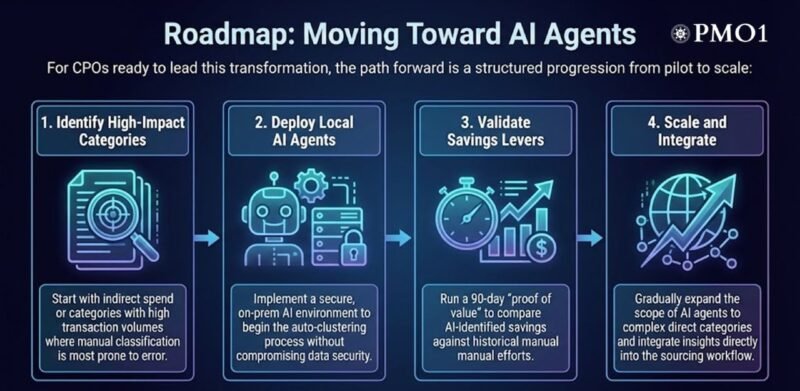
For CPOs ready to lead this transformation, the path forward is a structured progression from pilot to scale:
-
Identify High-Impact Categories: Start with indirect spend or categories with high transaction volumes where manual classification is most prone to error.
-
Deploy Local AI Agents: Implement a secure, on-prem AI environment to begin the auto-clustering process without compromising data security.
-
Validate Savings Levers: Run a 90-day “proof of value” to compare AI-identified savings against historical manual efforts.
-
Scale and Integrate: Gradually expand the scope of AI agents to complex direct categories and integrate insights directly into the sourcing workflow.
The future of category management is not found in more analysts or more complex spreadsheets. It is found in the deployment of intelligent, local agents that turn data into a continuous source of competitive advantage.
—————————
PMO1 is the Local AI Agent Suite built for the sovereign enterprise. By deploying powerful AI agents directly onto your private infrastructure, PMO1 enables organizations to achieve breakthrough productivity and efficiency with zero data egress. We help forward-thinking firms lower operational costs and secure their future with an on-premise solution that guarantees absolute control, compliance, and independence. With PMO1, your data stays yours, ensuring your firm is compliant, efficient, and ready for the future of AI.