

Bulk Up Your Strategy With On-Prem M&A Due Diligence AI agents
In the high-stakes arena of Mergers and Acquisitions (M&A), velocity and precision are the twin pillars of value creation. Yet, for decades, the due diligence process has remained fundamentally manual, labor-intensive, and prone to “sampling bias.” We typically see deal teams reviewing only a fraction of available documents, relying on static financial snapshots, and often missing the subtle signals of value leakage buried within terabytes of unstructured data.
As we enter the next phase of the digital economy, this traditional model is no longer tenable. The integration of on-premise AI Agents into the deal lifecycle represents a paradigmatic shift from passive data review to active, autonomous deal intelligence.
By deploying AI agents within a secure, air-gapped environment, organizations can now automate deal flow analysis, perform real-time risk scoring, and accelerate post-merger integration (PMI) planning—reducing diligence timelines by upwards of 80% while maintaining absolute data sovereignty.
Why Traditional M&A Due Diligence Needs Update
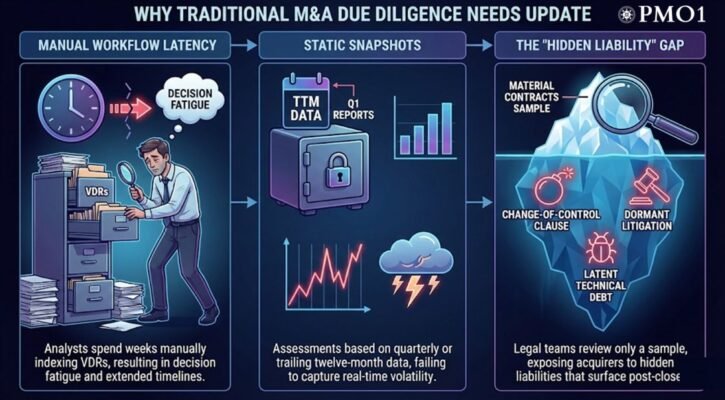
The complexity of modern enterprise architecture and the sheer volume of data involved in a transaction have outpaced the capacity of human-only deal teams. The traditional diligence model suffers from three structural failures:
-
Manual Workflow Latency: Analysts spend weeks manually indexing Virtual Data Rooms (VDRs), resulting in decision fatigue and extended timelines that kill deal momentum.
-
Static Snapshots: Financial and operational assessments are often based on quarterly reports or trailing twelve-month (TTM) data, failing to capture real-time volatility or emerging risks.
-
The “Hidden Liability” Gap: Due to time constraints, legal teams often review only material contracts or a statistical sample. This leaves the acquirer exposed to hidden liabilities – such as obscure change-of-control clauses, dormant litigation, or latent technical debt – that only surface post-close.
What Are On-Prem AI Agents for M&A?
An AI Agent differs from a standard analytical tool in its agency. While a standard tool answers a specific query, an AI Agent observes an objective, breaks it down into tasks, executes those tasks autonomously, and iterates based on findings.
In the context of M&A, a Deal Intelligence Agent is an autonomous software system designed to ingest the entirety of a target’s data ecosystem, understand context, and flag risks without human intervention.
Critically, the on-premise deployment of these agents is non-negotiable for enterprise transactions. M&A data represents the “crown jewels” of corporate strategy—intellectual property, customer lists, and sensitive financial projections. Exposing this data to public cloud Large Language Models (LLMs) introduces unacceptable third-party risk. On-prem AI ensures that zero data leaves the organization’s secure perimeter, aligning with strict data sovereignty mandates.
Inside the Deal Intelligence Agent Architecture
To deliver board-ready insights, the Deal Intelligence Agent operates through a sophisticated, multi-layered architecture designed for comprehensive coverage and auditability.
Data Ingestion Layer
The agent creates a unified data plane, ingesting and normalizing data from disparate sources irrespective of format. This includes:
-
Unstructured Data: Legal contracts (NDAs, MSAs), IP agreements, emails, and PDF reports.
-
Structured Data: ERP dumps, P&L statements, balance sheets, and cash flow logs.
-
External Signals: Market sentiment analysis, regulatory filings, and competitive intelligence.
AI Risk Engines
Once ingested, specialized sub-agents apply distinct logic models to the data:
-
Legal Risk Engine: Scans for non-standard clauses, indemnification caps, and change-of-control provisions.
-
Financial Anomaly Engine: Identifies revenue recognition irregularities, unexpected EBITDA adjustments, or customer concentration risks that exceed risk appetite thresholds.
-
Cyber & Tech Debt Engine: Analyzes code repositories and IT architecture documentation to quantify the cost of remediation and integration.
Explainability & Audit Trails
For an AI finding to be defensible in a boardroom, it must be explainable. The agent provides a “citation layer,” linking every risk score directly to the source document and page number. This allows Investment Committees to validate findings instantly, transforming “black box” outputs into verifiable evidence.
Automating Deal Flow and Risk Scoring
The primary value driver of the Deal Intelligence Agent is the Continuous Risk Scorecard. Rather than a static report delivered at the end of a six-week sprint, the agent maintains a dynamic dashboard that updates as new information enters the VDR.
-
Continuous Risk Detection: The agent monitors for inconsistencies between financial claims and contractual realities (e.g., revenue recognized before service delivery).
-
Dynamic Scoring Models: Each potential deal is assigned a composite score (0–100) based on weighted vectors including financial health, legal exposure, and operational maturity.
-
Scenario Analysis: Strategy leaders can run autonomous simulations—”What happens to the margin impact if we divest the APAC division?”—with the agent recalculating the deal model in real-time.
From Diligence to Integration Planning
The failure of most M&A deals occurs not during the transaction, but during the integration. AI agents bridge this gap by starting the integration planning process during the diligence phase.
-
Day-1 Readiness: Agents map employees, systems, and processes between the acquirer and the target, identifying redundancies automatically.
-
Synergy Validation: By analyzing the target’s supply chain and procurement data, the agent quantifies achievable cost synergies with high precision, moving beyond “top-down” estimates to “bottom-up” validation.
-
Technology & Operating Model Alignment: The agent flags incompatible technology stacks or software licensing conflicts early, allowing the CIO to budget for migration costs accurately before the deal price is finalized.
Quantifiable Business Impact
The shift to AI-driven diligence is not merely an operational upgrade; it is a competitive advantage. Early adopters report significant measurable impacts:
-
Timeline Reduction: Diligence cycles are compressed significantly, allowing firms to close viable deals faster or walk away from bad deals sooner.
-
Cost Savings: drastic reduction in billable hours for external counsel and consultants for routine document review.
-
Improved Deal Confidence: Reviewing 100% of documents rather than a 10% sample eliminates statistical blind spots, allowing for tighter valuation spreads and risk-adjusted pricing.
Security, Compliance, and Governance by Design
For the C-Suite, the deployment of AI in M&A is a governance issue. On-premise AI agents address the critical requirements of enterprise security:
-
Zero Data Exfiltration: The model runs locally on the enterprise’s private infrastructure. No training data is sent to external model providers (e.g., OpenAI, Anthropic), preserving trade secrets.
-
Regulatory Alignment: On-prem deployment ensures compliance with GDPR, CCPA, and industry-specific regulations (HIPAA, SOC 2), as data never crosses jurisdictional borders.
-
Role-Based Access Control (RBAC): The agent respects existing permission structures, ensuring that sensitive deal information is only accessible to authorized members of the deal team.
The era of manual, analog due diligence is ending. As transaction volumes recover and complexity increases, the ability to synthesize vast amounts of information into actionable intelligence will differentiate the market leaders from the laggards.
On-premise AI agents offer a secure, scalable path to modernized M&A. They empower executives to move from “trust but verify” to “verify, then trust.” For CEOs and Boards, the question is no longer whether to adopt AI in deal-making, but how quickly they can deploy these agents to secure their next strategic advantage.
—————————
PMO1 is the Local AI Agent Suite built for the sovereign enterprise. By deploying powerful AI agents directly onto your private infrastructure, PMO1 enables organizations to achieve breakthrough productivity and efficiency with zero data egress. We help forward-thinking firms lower operational costs and secure their future with an on-premise solution that guarantees absolute control, compliance, and independence. With PMO1, your data stays yours, ensuring your firm is compliant, efficient, and ready for the future of AI.