

Unified Multi-Channel Sales Orchestrator: One Secure AI Sales Agent
In the current high-velocity commercial environment, the primary bottleneck to revenue growth is no longer a lack of leads, but the fragmentation of response. For the Chief Sales Officer (CSO), the modern sales floor has moved beyond the office walls into a sprawling digital ecosystem of email, web chat, voice, and social messaging.
When buyer engagement is scattered across these disconnected channels, the result is inevitable: inconsistent response times, decayed buyer intent, manual handoff errors, and a total loss of visibility into the “middle of the funnel.” This is not a productivity issue to be solved with more headcount or another point solution; it is a revenue leakage and governance crisis.
The solution is the Unified Sales Orchestrator: a secure, autonomous agentic layer that centralizes multi-channel execution under a single Zero-Trust architecture. This is not a chatbot; it is a strategic enterprise capability designed to ensure that every inbound signal is met with immediate, high-context commercial discipline.
The Modern Sales Reality: Fragmentation Slows Revenue
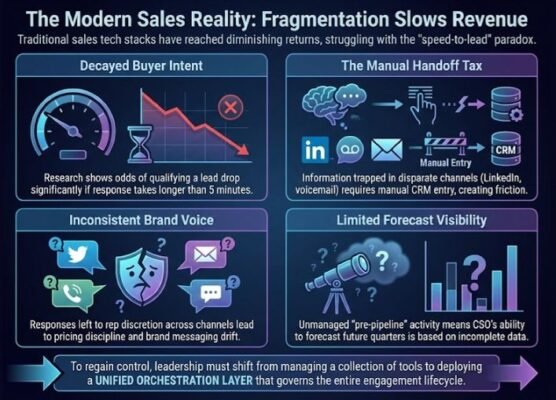
The traditional sales tech stack has reached a point of diminishing returns. Despite billions invested in CRM and sales engagement platforms, most organizations still struggle with the “speed-to-lead” paradox.
-
Decayed Buyer Intent: Research consistently shows that the odds of qualifying a lead drop by 10x if the response takes longer.
-
The Manual Handoff Tax: Information trapped in a LinkedIn message or a voice mail requires manual entry into the CRM. This creates “dark data” that the organization cannot analyze or act upon.
-
Inconsistent Brand Voice: When responses are left to individual rep discretion across four different channels, pricing discipline and brand messaging inevitably drift.
-
Limited Forecast Visibility: If the “pre-pipeline” activity is unmanaged, the CSO’s ability to forecast future quarters is based on incomplete data.
To regain control, leadership must shift from managing a collection of tools to deploying a unified orchestration layer that governs the entire engagement lifecycle.
Defining the Unified Sales Orchestrator
A Unified Sales Orchestrator is an enterprise-grade AI agent that serves as the central nervous system for inbound demand. It operates as a persistent, secure layer between your communication channels and your core systems of record.
It is critical to distinguish this from legacy tools:
-
vs. CRM Workflows: While CRM workflows are reactive and linear, the orchestrator is proactive and contextual, making real-time decisions based on live data.
-
vs. Chatbots: Traditional chatbots are siloed and script-bound. The orchestrator is omnichannel, maintaining a single “thread of truth” whether the buyer interacts via email, phone, or LinkedIn.
-
vs. Marketing Automation: Marketing tools focus on “broadcast” logic. The orchestrator focuses on “transactional” logic, moving the buyer toward a specific commercial outcome (e.g., a meeting, a quote, or a demo).
How the Orchestrator Works: Observe, Orient, Decide, Act
The power of a unified agent lies in its ability to execute the OODA loop (Observe, Orient, Decide, Act) at machine speed across the entire enterprise.
Multi-Channel Monitoring
The agent “listens” to every inbound channel—Email (SMTP), Web Chat (API), Phone/Voice (SIP/VoIP), and Social Messaging—simultaneously. It does not wait for a human to log in; it is 24/7 infrastructure.
Intent and Context Evaluation
Upon receiving a signal, the orchestrator performs an instant lookup. It queries the CRM for deal history, checks the ERP for contract status, and analyzes the buyer’s intent. Is this a pricing inquiry from a Tier-1 account, or a support request from a legacy client?
Real-Time Decisioning and Execution
Based on pre-defined commercial rules and guardrails, the agent selects the next best action:
-
Autonomous Response: If the query is a request for technical specs or standard pricing, the agent provides it instantly.
-
Meeting Orchestration: It accesses the appropriate seller’s calendar and books a discovery call without back-and-forth emails.
-
Intelligent Routing: If the deal context suggests high complexity, it escalates to a human seller with a full briefing.
-
Asset Deployment: It pushes relevant case studies or demo links tailored to the specific buyer persona.
Systemic Accountability
Crucially, the orchestrator writes every interaction back to the CRM. This ensures that the system of record is a perfect reflection of reality, providing a full audit trail of the buyer journey.
Why On-Prem and Zero-Trust Are Non-Negotiable
For the CSO, data is the most valuable intellectual property in the sales engine. Entrusting that data to public, multi-tenant AI models is a strategic risk.
-
IP Protection: Your pricing models, negotiation playbooks, and customer lists must remain within your controlled environment. An on-prem-first deployment ensures that your proprietary data is never used to train a competitor’s model.
-
Regulatory Compliance: In highly regulated industries (Finance, Healthcare, Defense), data residency is a legal mandate. A unified orchestrator running in a private cloud or on-prem environment satisfies these requirements natively.
-
Zero-Trust Enabler: By applying a Zero-Trust policy, every action the agent takes is verified and authorized. The agent is treated as a privileged internal entity, subject to the same identity and access management (IAM) controls as your top-performing reps.
Zero-Trust is not a barrier to speed; it is the foundation of scale. It allows the organization to automate 80% of sales interactions with the absolute certainty that no unauthorized commitments are being made.
Strategic Value for the CSO: Moving the Needle
The implementation of a sales orchestrator transforms the sales organization from a reactive cost center to a high-velocity revenue engine.
-
Revenue Velocity: By collapsing response times from hours to seconds, you maximize the “golden window” of buyer interest, leading to a measurable lift in conversion rates.
-
Increased Seller Focus: By offloading 70–80% of routine qualification and scheduling to the agent, your most expensive human capital (AEs and Enterprise Reps) can focus exclusively on high-value, high-complexity closing activities.
-
Consistent Commercial Discipline: The orchestrator never misses a follow-up and never goes “off-script” with pricing. This ensures a consistent brand experience that protects margins.
-
Forecast Integrity: With every interaction logged automatically, “dark activity” is eliminated. CSOs can trust their pipeline data because it is being fed by an objective, tireless system rather than manual rep entry.
Operating Model Implications
This is not a software rollout; it is an evolution of the commercial operating model. Success requires a new alignment between Sales, IT, and Security.
-
Governance Ownership: Sales Operations must own the “rules of engagement,” while IT and Security own the “infrastructure of trust.”
-
Integration with the Core: The orchestrator must be deeply integrated with the CRM (Salesforce/Dynamics), ERP, and IAM systems.
-
New KPIs: Leadership must move beyond activity metrics (calls made) to outcome-based metrics: response latency, lead-to-meeting conversion lift, and rep capacity utilization.
What CSOs Should Do Now: A Roadmap to Scale
The transition to unified sales orchestration should be executed with consulting-grade precision:
-
The Pilot (Months 1-2): Identify a single high-volume motion—such as inbound trial requests or “Contact Sales” web forms. Deploy the orchestrator in a private environment to prove the Zero-Trust logic.
-
The Multi-Channel Bridge (Months 3-4): Expand the agent to handle email and LinkedIn outreach, ensuring the logic stays consistent across both.
-
The Scale-Up (Months 6+): Integrate voice/phone channels and roll out across global territories.
The mandate for the CSO is clear: In an age of autonomous commerce, speed and security are the new competitive advantages. A Unified Sales Orchestrator provides the control you need to scale and the velocity your buyers demand.
—————————
PMO1 is the Local AI Agent Suite built for the sovereign enterprise. By deploying powerful AI agents directly onto your private infrastructure, PMO1 enables organizations to achieve breakthrough productivity and efficiency with zero data egress. We help forward-thinking firms lower operational costs and secure their future with an on-premise solution that guarantees absolute control, compliance, and independence. With PMO1, your data stays yours, ensuring your firm is compliant, efficient, and ready for the future of AI.