
Why On-Prem Strategy AI Agents Your Secret Weapon
In the traditional corporate calendar, the Annual Strategy Planning cycle is often a linear, labor-intensive process—a “snapshot in time” that is frequently obsolete by the end of Q1. I have observed that the most resilient organizations are moving away from static slide decks toward Autonomous Strategy Engines.
For the Chief Strategy Officer (CSO), the decision of where these engines reside is not a technical footnote; it is a foundational pillar of competitive advantage. While cloud-based AI offers convenience, On-Prem Strategy AI Agents are emerging as the essential tool for those who must architect the future of the firm without compromising its most sensitive intellectual property.
The Strategic Context: Why Deployment Model Now Matters
The modern CSO’s mandate has expanded from “facilitator” to “architect of intelligence.” In an environment characterized by extreme volatility, the ability to run 10,000 simulations of a Corporate Strategy design overnight is a requirement, not a luxury.
However, when you feed your 5-year financial projections, M&A targets, and proprietary cost structures into a public cloud LLM, you are effectively “exporting” your strategic intent. For the CSO, the deployment model matters because of three core imperatives:
-
Intellectual Property Density: Strategy models contain the most sensitive data in the firm.
-
Model Customization: General-purpose AI lacks the “institutional memory” of your specific market maneuvers and organizational constraints.
-
Strategic Autonomy: The ability to pivot strategy in real-time, independent of external service availability or third-party logic changes.
Defining the On-Prem Strategy AI Agent
For the CSO, an On-Prem Strategy AI Agent is a specialized, autonomous system deployed within the enterprise’s secure ecosystem. It is designed to act as a Digital Chief of Staff, capable of performing high-order strategic reasoning.
Unlike standard SaaS copilots, these agents are integrated into your internal Strategy Plan Models:
-
Financial Modeling: They don’t just calculate; they stress-test P&L assumptions against historical internal performance and external market signals.
-
Annual Strategy Planning: They synthesize inputs from disparate business units, identifying misalignments in real-time.
-
Corporate Strategy Design: They analyze internal talent capabilities and operational bottlenecks to determine if a proposed strategic shift is actually executable.
The CSO’s Secret Weapon: Four Pillars of Advantage
Leading CSOs are adopting on-prem architectures to unlock capabilities that cloud-only models cannot safely provide.
1. High-Fidelity Financial Modeling
On-prem agents can access granular, non-anonymized financial data—down to the SKU and customer level—without breaching data privacy mandates. This allows for a level of Financial Modeling precision that enables “what-if” scenarios which are too sensitive to ever leave the building.
2. Safeguarding the “Strategy Moat”
Your strategy is only an advantage if it remains a secret. Using on-prem agents ensures that your unique competitive logic—your “moat”—is never used to inadvertently train a model that your competitor might use tomorrow. It keeps the Corporate Strategy Design entirely within the firm’s “sovereign air-gap.”
3. Accelerated Synthesis in Annual Planning
The most painful part of Annual Strategy Planning is the manual synthesis of bottom-up data. On-prem agents can ingest thousands of internal memos, budget sheets, and operational reports, providing the CSO with a “Red Team” analysis that highlights inconsistencies between the CEO’s vision and the front-line reality.
4. Custom Strategy Logic
Every firm has a unique “way of winning.” On-prem deployment allows the Strategy team to fine-tune AI agents on the firm’s historical decision-making frameworks. This results in an agent that understands your specific risk appetite and capital allocation philosophy.
Security, Governance, and the CSO’s Risk Profile
For the CSO, the risks of AI—hallucination, data leakage, and lack of auditability—are strategic risks. On-premise agents provide a Deterministic Control Plane:
-
Traceable Logic: When an agent suggests divesting a business unit, the CSO can audit the exact data points and logic gates used, ensuring the recommendation is grounded in fact, not “probabilistic guessing.”
-
Zero-Trust Strategy: By keeping the strategy engine local, the CSO mitigates the risk of “industrial espionage via prompt injection” that haunts public-facing cloud AI.
-
Regulatory Alignment: For firms in defense, banking, or healthcare, on-prem is often the only way to satisfy the Board that AI-driven strategy complies with strict data residency laws.
Implications for the Strategy Operating Model
Transitioning to an AI-augmented strategy function requires a shift in how the CSO’s office is structured:
-
From Research to Validation: The Strategy team spends less time “finding data” and more time “validating AI-generated hypotheses.”
- The “Human-in-the-Loop” Mandate: The CSO must define the “Judgment Threshold” – the point where the AI’s recommendation ends and the executive committee’s decision begins.
The Executive Roadmap
To turn On-Prem Strategy AI Agents into a reality, CSOs should follow a disciplined sequence:
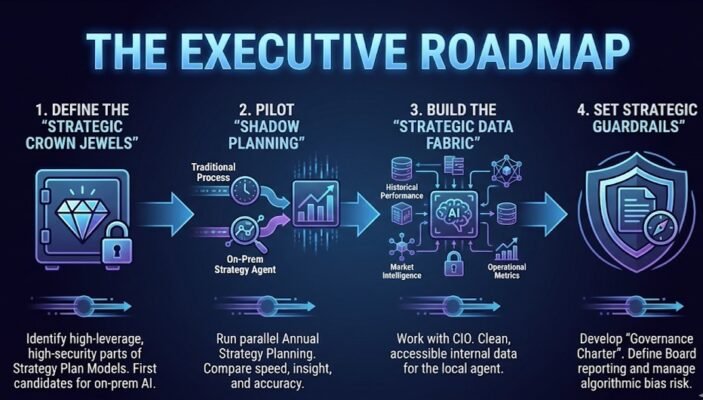
1. Define the “Strategic Crown Jewels”
Identify which parts of your Strategy Plan Models provide the highest competitive leverage and require the highest security. These are your first candidates for on-prem AI.
2. Pilot “Shadow Planning”
Run your upcoming Annual Strategy Planning cycle in parallel: use your traditional process and simultaneously run an on-prem strategy agent. Compare the speed, depth of insight, and accuracy of the financial models produced.
3. Build the “Strategy Data Fabric”
Work with the CIO to ensure that internal data—historical performance, market intelligence, and operational metrics—is clean and accessible to the local agent.
4. Set Strategic Guardrails
Develop a “Governance Charter” for AI in strategy. Define how the Board will be informed of AI’s role in decision-making and how the firm will manage the risk of “algorithmic bias” in its corporate design.
Securing the Future of the Firm
The role of the CSO is to ensure the long-term viability and growth of the enterprise. In a world where AI is becoming the primary engine of productivity, the infrastructure of that AI is a strategic choice. On-Prem Strategy AI Agents provide the security, precision, and autonomy required to lead in a high-stakes environment.
The most successful CSOs of the next decade will not be those who simply “use” AI, but those who own their intelligence. By bringing the strategy engine inside the house, you ensure that your most brilliant moves remain your own.
Would you like me to draft a Board-level briefing memo that outlines the investment case for transitioning your Annual Strategy Planning to an on-premise AI-augmented model?
—————————
PMO1 is the Local AI Agent Suite built for the sovereign enterprise. By deploying powerful AI agents directly onto your private infrastructure, PMO1 enables organizations to achieve breakthrough productivity and efficiency with zero data egress. We help forward-thinking firms lower operational costs and secure their future with an on-premise solution that guarantees absolute control, compliance, and independence. With PMO1, your data stays yours, ensuring your firm is compliant, efficient, and ready for the future of AI.