

Improve Efficiency With On-Prem Procurement Spend Analysis AI Agents
In an era of persistent supply chain volatility and margin compression, the Chief Procurement Officer (CPO) faces a dual mandate: deliver aggressive savings targets and ensure absolute operational resilience. Historically, the foundation of meeting these objectives has been spend analysis—the ability to see, classify, and interpret external expenditure.
However, for many global enterprises, true spend visibility remains an elusive quarterly exercise rather than a real-time capability. The reliance on manual data aggregation, fragmented ERP landscapes, and static spreadsheets renders spend data obsolete by the time it reaches the boardroom.
The emergence of on-premise Procurement AI Agents represents a paradigm shift. Unlike traditional analytics suites or cloud-native GenAI tools that pose data sovereignty risks, on-prem AI agents offer a secure, autonomous architecture. They reduce analysis cycles from months to days, transforming the procurement function from a back-office reporting center to a strategic engine of value creation.
Why Traditional Spend Analysis Fails Modern Procurement
For the modern CPO, the “rearview mirror” approach to spend analysis is no longer tenable. In most Fortune 500 organizations, spend data is trapped in silos—scattered across SAP, Oracle, legacy mainframes, and thousands of unstructured invoices and contracts.
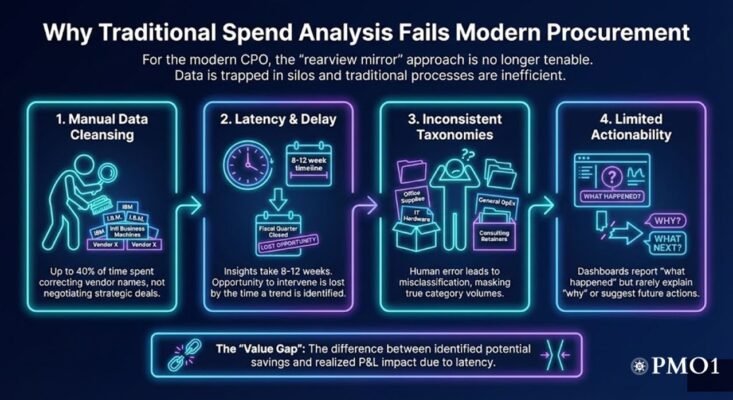
The traditional process to bridge these silos is fraught with inefficiency:
-
Manual Data Cleansing: Highly paid category managers spend up to 40% of their time correcting vendor names (e.g., normalizing “IBM,” “I.B.M.,” and “Intl Business Machines”) rather than negotiating strategic deals.
-
Latency: The cycle time from data extraction to actionable insight often spans 8 to 12 weeks. By the time a CPO identifies a leakage trend, the fiscal quarter has closed, and the opportunity to intervene is lost.
-
Inconsistent Taxonomies: Human error leads to misclassification. IT hardware is buried in “Office Supplies,” and consulting retainers are hidden in “General OpEx,” masking true category volumes.
-
Limited Actionability: Traditional dashboards report what happened, but rarely explain why or suggest what to do next.
This latency creates a “value gap” – the difference between identified potential savings and realized P&L impact.
What Are On-Prem Procurement AI Agents?
To close the value gap, procurement leaders are moving beyond rules-based Robotic Process Automation (RPA) toward agentic AI.
A Procurement AI Agent is not a passive dashboard. It is an autonomous software entity capable of perceiving data, reasoning to categorize it, and taking action to refine insights. Unlike standard generative AI models that require sending proprietary data to the public cloud, on-prem AI agents are deployed entirely within the enterprise’s private infrastructure (or virtual private cloud).
This on-prem distinction is critical. Procurement data contains some of an organization’s most sensitive trade secrets—specifically, negotiated supplier pricing structures, rebate terms, and strategic component volumes. CPOs and CIOs cannot risk exposing this “crown jewel” data to public Large Language Models (LLMs) for training purposes. On-prem agents bring the intelligence to the data, ensuring zero exfiltration.
Inside the Procurement AI Agent Architecture
Successful deployment of AI in procurement requires a robust architecture that balances autonomy with governance.
Data Ingestion and Normalization
The AI agent connects directly to the enterprise data layer. It ingests structured data from ERPs and Procure-to-Pay (P2P) systems, as well as unstructured data from accounts payable (AP) invoices, PDF contracts, and supplier master data.
Because the agent operates continuously, it does not rely on “batch loads.” It detects a new invoice or PO the moment it is created, normalizing currency, units of measure, and supplier entities in near real-time.
Intelligent Classification and Enrichment
This is where the agent outperforms human analysts. Leveraging domain-specific Small Language Models (SLMs) fine-tuned on procurement taxonomies (such as UNSPSC or eCl@ss), the agent analyzes line-item descriptions with semantic understanding.
It does not merely look for keywords; it understands context. For example, it can discern that a payment to a software vendor is “Professional Services” if the invoice description references “implementation hours,” but “IT Software” if it references “license seats.” It then enriches this data with third-party risk scores and diversity ratings.
Explainability, Auditability, and Trust
For a CPO to trust an algorithm with billion-dollar spend categories, the “black box” problem must be solved. Modern on-prem agents offer Chain of Thought transparency. When an agent classifies a transaction or flags an anomaly, it provides a citation trail—linking the decision back to the specific contract clause or invoice line item. This ensures that all insights are audit-ready and defensible during supplier reviews.
Cutting Spend Analysis Time by 60–80%
The most immediate ROI of deploying on-prem AI agents is the dramatic compression of analysis timelines. By automating the heavy lifting of data preparation, organizations can achieve:
-
Elimination of Manual Effort: Agents handle the cleansing and mapping that typically consumes thousands of analyst hours annually. This frees teams to focus on supplier relationship management and innovation.
-
Continuous Refresh: Instead of a quarterly snapshot, the CPO has access to a “living” spend cube. Trends are updated daily or weekly, allowing for agile responses to market shifts.
-
Rapid Time-to-Insight: Complex queries that previously required a data science ticket—such as “Show me all off-contract spend with Tier 2 logistics providers in APAC” – can be answered in seconds via natural language interfaces.
Clients who have piloted this approach report a reduction in the time-to-insight cycle from 3 months to under 2 weeks, directly accelerating savings realization.
From Spend Visibility to Savings Execution
Visibility is the means; savings execution is the end. On-prem procurement AI agents transition the function from passive observation to active value capture.
-
Opportunity Identification: The agent proactively scans for price variances. If the organization is paying €1.50 for a widget in Germany but €1.20 for the exact same SKU in France, the agent flags this arbitrage opportunity immediately.
-
Demand Aggregation: By accurately classifying fragmented spend across business units, agents reveal opportunities to bundle volume and renegotiate master service agreements (MSAs).
-
Contract Compliance & Leakage: The agent cross-references invoice line items against digitized contract terms. It identifies overpayments, duplicate invoices, and “maverick spend” (purchasing outside of preferred contracts) before payment runs occur, stopping leakage at the source.
Security, Compliance, and Data Sovereignty by Design
For the C-Suite, the adoption of AI is often stalled by security concerns. On-prem procurement AI agents address these anxieties by design.
-
Zero Data Exfiltration: Because the model runs locally, sensitive pricing tables and supplier contracts never leave the corporate firewall. This satisfies the strict requirements of Chief Information Security Officers (CISOs).
-
Regulatory Alignment: For global companies, data residency is paramount. On-prem deployments ensure that data originating in the EU (GDPR) or China (CSL) is processed locally, avoiding cross-border compliance violations.
-
Internal IT Alignment: These agents integrate with existing Identity and Access Management (IAM) protocols, ensuring that access to sensitive spend views is restricted based on role and seniority.
The role of the CPO is evolving from the guardian of the purse strings to a strategic architect of value and resilience. To fulfill this potential, procurement leaders must dismantle the manual, backward-looking processes that throttle speed and obscure visibility.
On-prem procurement AI agents offer the necessary bridge. By automating the chaotic reality of spend data within a secure, sovereign environment, they empower CPOs to move faster than the market. The organizations that adopt this technology today will not only realize savings faster but will establish a data advantage that competitors relying on spreadsheets cannot match.
—————————
PMO1 is the Local AI Agent Suite built for the sovereign enterprise. By deploying powerful AI agents directly onto your private infrastructure, PMO1 enables organizations to achieve breakthrough productivity and efficiency with zero data egress. We help forward-thinking firms lower operational costs and secure their future with an on-premise solution that guarantees absolute control, compliance, and independence. With PMO1, your data stays yours, ensuring your firm is compliant, efficient, and ready for the future of AI.