

What Are AI Agents? A Strategic Guide for CEOs & Boards (2025)
The Agentic Shift: Moving from Digital Tools to a Digital Workforce: For the past two years, the corporate world has been captivated by Generative AI. We have marveled at its ability to summarize emails, draft code, and synthesize vast amounts of knowledge. Yet, for all its prowess, this first wave of technology remained fundamentally passive. It waited for a prompt; it required a human to hit “enter.” It was a tool, not a worker.
We are now entering a new phase of the artificial intelligence maturity curve: the era of the AI Agent.
This transition marks a departure from merely generating content to executing action. While a Large Language Model (LLM) can write a strategy document, an AI Agent can research the market, draft the plan, schedule the review meeting, and update the CRM—autonomously. For CEOs and board members, this distinction is not semantic; it is economic. We are witnessing the decoupling of labor from human biology, effectively creating a scalable, digital workforce that operates alongside your human talent.
The question for the boardroom is no longer “How do we use AI?” The question is “How do we employ it?”
What Distinguishes an Agent?
To understand the strategic implications, one must first grasp the functional difference between a standard bot and an agent. A chatbot talks; an agent acts.
An AI Agent possesses four distinct characteristics that allow it to function as a digital employee:
1. Goal-Directed Autonomy Traditional software follows a script. If A happens, do B. An AI Agent, however, pursues a high-level goal. You might instruct it to “optimize our cloud spend by 15%.” The agent will independently figure out the necessary steps, analyze usage patterns, identify waste, and potential solutions without requiring a line-by-line instruction manual.
2. Reasoning and Planning Agents do not just predict the next word; they predict the next step. They utilize “chain-of-thought” reasoning to break down complex objectives into manageable sub-tasks. They critique their own plans, adjust for errors, and re-prioritize on the fly if obstacles arise.
3. Tool Use and Action This is the critical unlock. Agents are given “hands” in the form of API integrations. They can access the internet, write to databases, send emails, and execute financial transactions. They bridge the gap between digital intelligence and digital execution.
4. Memory and Context Unlike a chat session that resets when you close the window, an agent retains institutional memory. It learns from past interactions, remembers user preferences, and maintains context over weeks or months, allowing it to improve its performance curve over time.
The Three Horizons of Agentic AI
Implementing AI agents is not a technology upgrade; it is an organizational redesign. Leaders should view this transformation through a three-horizon framework.
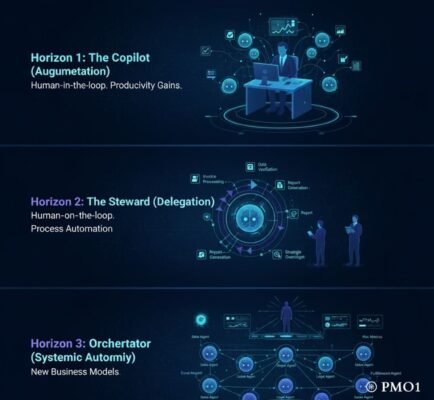
Horizon 1: The Copilot (Augmentation)
- The Model: Human-in-the-loop.
- The Function: The agent acts as a force multiplier for a specific employee. It drafts responses, surfaces data during meetings, or writes boilerplate code. The human retains full control and accountability.
- The Value: Productivity gains (10-30%) in individual tasks.
Horizon 2: The Steward (Delegation)
- The Model: Human-on-the-loop.
- The Function: The agent takes ownership of a specific workflow. For example, an agent might manage the entire accounts payable process: receiving invoices, verifying them against purchase orders, and scheduling payments. The human only intervenes for exceptions or final approval.
- The Value: Process speed, error reduction, and 24/7 operational capacity.
Horizon 3: The Orchestrator (Systemic Autonomy)
-
The Model: Human-out-of-the-loop (governance only).
-
The Function: Multiple agents collaborate to solve complex problems. A “Sales Agent” might qualify a lead and hand it off to a “Legal Agent” to draft a contract, who then signals a “Fulfillment Agent” to begin logistics planning.
-
The Value: New business models and hyper-scalability. The organization moves from managing people to orchestrating outcomes.
The Boardroom Agenda: Risk and Governance
The shift to agentic systems introduces new risk vectors that the board must proactively manage.
The Alignment Problem When you give software autonomy, you must ensure its goals align with corporate values. An agent instructed to “maximize profit” might decide to eliminate all customer service costs unless strict guardrails are in place. Governance frameworks must define the “rules of engagement” for digital workers:
Data Sovereignty and Security Agents require deep access to core systems (ERP, CRM, HRIS). This expands the attack surface. Security protocols must evolve from user-based access to role-based agentic access, ensuring that a compromised agent cannot bring down the enterprise.
The Talent Pivot As agents assume procedural work, the value of human capital shifts towards judgment, strategy, and empathy. The organization must prepare to upskill the workforce to manage these digital colleagues. We are moving from being operators of tools to managers of bots.
The arrival of AI Agents represents a restructuring of the unit of production. It offers a path to escape the linear relationship between headcount and revenue. However, this is not a plug-and-play solution. It requires a deliberate architectural approach, robust governance, and a willingness to reimagine how value is created.
The future belongs to organizations that can successfully harmonize biological and digital labor into a single, cohesive strategy.
_______________
PMO1 is the Local AI Agent Suite built for the sovereign enterprise. By deploying powerful AI agents directly onto your private infrastructure, PMO1 enables organizations to achieve breakthrough productivity and efficiency with zero data egress. We help forward-thinking firms lower operational costs and secure their future with an on-premise solution that guarantees absolute control, compliance, and independence. With PMO1, your data stays yours, ensuring your firm is compliant, efficient, and ready for the future of AI.