
Why You Need Strategy AI Agents
For decades, the ritual of corporate strategy has remained unchanged. Once a year, leadership teams retreat to an offsite, digest hundreds of PowerPoint slides, and emerge with a static five-year plan. This artifact, polished and precise, is often obsolete the moment the ink is dry. In a world of non-linear disruption—where supply chains fracture overnight and competitors emerge from adjacent industries—the cadence of human-led strategy is simply too slow.
We are witnessing a fundamental inversion in how value is protected and created. The traditional approach relies on “periodic intelligence.” The new paradigm demands “continuous agency.”
Enter the Strategy AI Agent.
Unlike the Generative AI tools that summarize your emails or draft marketing copy, Strategy Agents are a different class of digital asset. They do not just retrieve information; they reason through it. They are autonomous software entities capable of modeling infinite scenarios, monitoring competitive signals 24/7, and proactively recommending course corrections.2 For the CEO and the Board, these agents are not merely productivity tools. They are the necessary infrastructure for a new era of dynamic, resilient decision-making.
The Anatomy of a Strategy Agent
To understand the value at stake, one must distinguish a Strategy Agent from a standard Large Language Model (LLM). While an LLM is a library of the past, a Strategy Agent is a simulator of the future.
These agents possess three distinctive attributes that allow them to function as high-level thought partners:
1. Recursive Scenario Wargaming
A human strategist can model perhaps three scenarios: Best Case, Worst Case, and Base Case. A Strategy Agent can model thousands simultaneously. It can simulate the second and third-order effects of a pricing change, a geopolitical shock, or a competitor’s merger. It runs these simulations recursively, learning from each iteration to refine the probability of success. This is not just forecasting; it is continuous, automated wargaming.
2. Cross-Silo Synthesis
In most enterprises, insight is trapped in silos. The supply chain data does not speak to the customer sentiment data. Strategy Agents traverse these boundaries. They connect the dots between a delayed shipment in Shenzhen (Logistics), a spike in customer churn in California (Sales), and a dip in cash flow reserves (Finance). They synthesize this disparate noise into a coherent strategic signal, alerting the C-suite to risks that no single human function could see.3
3. Goal-Directed Autonomy
Standard software waits for a command. Strategy Agents pursue a “North Star.” If you task an agent with “Monitoring aggressive competitor discounting in the APAC region,” it does not sleep. It actively scans pricing scraping data, earnings call transcripts, and local news. When it detects a threshold breach, it does not just flag it; it can draft a defensive pricing strategy and queue it for executive review.
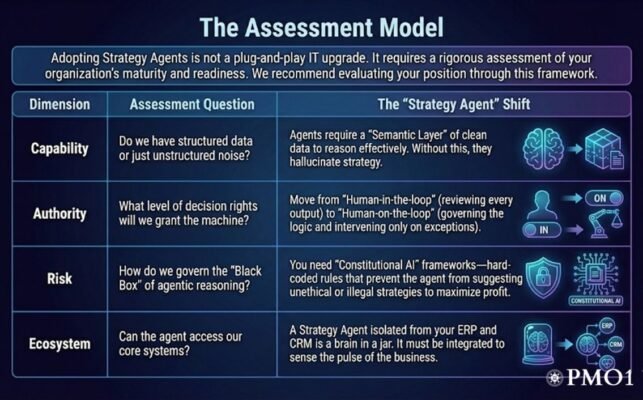
The Assessment Model
Adopting Strategy Agents is not a plug-and-play IT upgrade. It requires a rigorous assessment of your organization’s maturity and readiness. We recommend evaluating your position through this framework.
The Board’s Imperative
The risk here is not just technical; it is fiduciary. Boards must ask themselves: Is our strategy based on data from last quarter, or simulations of tomorrow?
The implementation of Strategy Agents will bifurcate the market. On one side, firms that rely on static planning cycles will find themselves constantly reacting to “unforeseen” shocks. On the other, firms with a layer of Strategy Agents will navigate turbulence with pre-calculated precision. They will have already “lived” the crisis in a simulation before it happens in reality.
The era of the static strategic plan is ending. We are moving toward “Strategy-as-Code”—a continuous, living process where human judgment is amplified by machine scale.
Strategy Agents do not replace the CEO. They liberate the CEO from the noise of data gathering, allowing them to focus on the one thing an agent cannot do: define the vision and values that make the trade-offs worth making.
_______________
PMO1 is the Local AI Agent Suite built for the sovereign enterprise. By deploying powerful AI agents directly onto your private infrastructure, PMO1 enables organizations to achieve breakthrough productivity and efficiency with zero data egress. We help forward-thinking firms lower operational costs and secure their future with an on-premise solution that guarantees absolute control, compliance, and independence. With PMO1, your data stays yours, ensuring your firm is compliant, efficient, and ready for the future of AI.